

Jeet Kune Do
The Guardian FistWay of the Intercepting Fist
Sifu Riddhi Dutta – Pioneering Figure of Jeet Kune Do in the City of Joy
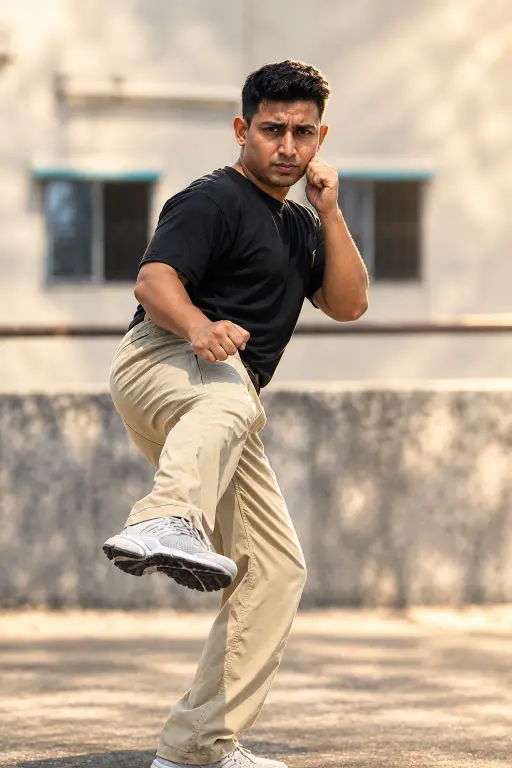
SPECIAL FEATURES OF THE SYSTEM
WHAT IS JEET KUNE DO BEST SUITABLE FOR ?
4 RANGE FIGHTING SYSTEM
PRACTICAL SELF-DEFENSE
STUDY OF EFFICIENT AND EXPLOSIVE POWER GENERATION
FITNESS AND HEALTH
FOR CHOREOGRAPHING CINEMATIC ACTION SCENES IN MOVIES
WHAT IS JEET KUNE DO?
Jeet Kune Do, “The way of the intercepting fist” in Cantonese, abbreviated JKD, is a hybrid philosophy of martial arts heavily influenced by the personal philosophy and experiences of martial artist Bruce Lee. Lee, who founded the system on July 9, 1967, referred to it as “non-classical”, suggesting that JKD is a form of Chinese Kung Fu, yet without form. Unlike more traditional martial arts, Jeet Kune Do is not fixed or patterned, and is a philosophy with guiding thoughts. It was named for the Wing Chun concept of interception or attacking when one’s opponent is about to attack. Jeet Kune Do practitioners believe in minimal effort with maximum effect. On January 10, 1996, the Bruce Lee Foundation decided to use the name Jun Fan Jeet Kune Do (振藩截拳道) to refer to the martial arts system which Lee founded; “Jun Fan” being Lee’s Chinese given name.
Bruce Lee believed that kata forms and martial art tournament matches alike (like Karate) were simply “organized despair”. He believed that in order to “fully express oneself, one must have no limitations” (kata and rigid and non-flowing movements being the limitation). His system was revolutionary, and included all possible forms of strikes: attacks to the groin, finger jab to the eye.
Jeet Kune Do was often said by Lee to be just a name, and he often referred to it as “the art of expressing the human body” in his writings and in interviews. Through his studies Lee came to believe that styles had become too rigid and unrealistic. He called martial art competitions of the day “dry land swimming”. He believed real combat was spontaneous, and a martial artist cannot predict it, but only react to it, and a good martial artist should “be like water”—move fluidly without hesitation.
Originally, when Lee began researching various fighting styles, he called it Jun Fan Gung Fu. Not wanting to create another style which would share the limitations that all styles had, he instead described the process which he used to create it:
JKD as it survives since then—if one views it “refined” as a product, not a process—is what was left at the time of Lee’s death. It is the result of the lifelong martial arts development process Lee went through. Lee stated his concept does not add more and more things on top of each other to form a system, but rather selects the best thereof. The metaphor Lee borrowed from Chan Buddhism was of constantly filling a cup with water, and then emptying it, used for describing Lee’s philosophy of “casting off what is useless”. He used the sculptor’s mentality of beginning with a lump of clay and removing the material which constituted the “unessentials” the end result was what he considered to be the bare combat essentials, or JKD. The dominant or strongest hand should be in the lead because it would perform a greater percentage of the work. Lee minimized the use of other stances except when circumstances warranted such actions.
JEET KUNE DO PRINCIPLES
The following are principles that Lee incorporated into Jeet Kune Do. Lee felt these were universal combat truths that were self-evident, and would lead to combat success if followed. Familiarity with each of the “Four ranges of combat”, in particular, is thought to be instrumental in becoming a “total” martial artist. JKD teaches that the best defense is a strong offense, hence the principle of an “intercepting fist”. For someone to attack another hand-to-hand, the attacker must approach the target. This provides an opportunity for the attacked person to “intercept” the attacking movement. The principle of interception may be applied to more than intercepting physical attacks; non-verbal cues (subtle movements that an opponent may be unaware of) may also be perceived or “intercepted”, and thus be used to one’s advantage. The “Five ways of attack”, categories which help JKD practitioners organize their fighting repertoire, comprise the offensive teachings of JKD. The concepts of “Stop hits & stop kicks”, and “Simultaneous parrying & punching”, based on the concept of single fluid motions which attack while defending (in systems such as Épée fencing and Wing Chun), compose the defensive teachings of JKD. These concepts were modified for unarmed combat and implemented into the JKD framework by Lee to complement the principle of interception.
Stance
Seen in many of his movie fight scenes such as in The Way of the Dragon vs Chuck Norris, Bruce Lee fought in a side southpaw horse stance. His jabs and crosses came from his right hand and followed up with a lot of side kicks. Instead of a common check seen in Muay Thai, Bruce uses an oblique leg kick to block a potential kick. Bruce Lee adopted other defensive concepts found in many other systems such as slipping and rolling from Western Boxing and forearm blocks found in Eastern martial arts such as Kung Fu.
Footwork
Bruce Lee’s nimble and agile skipping-like footwork is seen in his movies. This technique was adopted from Muhammad Ali’s footwork in his boxing stance. This quick and agile footwork can be achieved from practice using a jump rope as jumping rope imitates this nimble, jumpy action that is a quick way to move your way around and away from an enemy’s strikes. Footwork also has its influences from fencing.
Strong side lead
Lee felt that the straight lead was the most integral part of Jeet Kune Do punching, as he stated, “The leading straight punch is the backbone of all punching in Jeet Kune Do.” The straight lead is not a power strike but a strike formulated for speed. The straight lead should always be held loosely with a slight motion, as this adds to its speed and makes it more difficult to see and block. The strike is not only the fastest punch in JKD, but also the most accurate. The speed is attributed to the fact that the fist is held out slightly making it closer to the target and its accuracy is gained from the punch being thrown straight forward from one’s centerline. The straight lead should be held and thrown loosely and easily, tightening only upon impact, adding to one’s punch. The straight lead punch can be thrown from multiple angles and levels.
Non-telegraphic
Lee felt that explosive attacks with no telegraphing signs of intention were best. He argued that the attacks should catch the opponent off-guard, throwing them off their balance and leaving them unable to defend against further attacks. “The concept behind this is that when you initiate your punch without any forewarning, such as tensing your shoulders or moving your foot or body, the opponent will not have enough time to react,” Lee wrote. The key is that one must keep one’s body and arms loose, weaving one’s arms slightly and only becoming tense upon impact. Lee wanted no wind-up movements or “get ready poses” to prelude any JKD attacks. Lee explained that any twitches or slight movements before striking should be avoided as they will give the opponent signs or hints as to what is being planned and then they will be able to strike first while one is preparing an attack. Consequently, non-telegraphed movement is an essential part of Jeet Kune Do philosophy.
Economy of motion
Jeet Kune Do seeks to waste no time or movement, teaching that the simplest things work best, as in Wing Chun. Economy of motion is the principle by which JKD practitioners achieve:
Efficiency: An attack which reaches its target in the least amount of time, with maximum force.
Directness: Doing what comes naturally in a disciplined way.
Simplicity: Thinking in an uncomplicated manner; without ornamentation.
This is meant to help a practitioner conserve both energy and time, two crucial components in a physical confrontation. Maximized force seeks to end the battle quickly due to the amount of damage inflicted upon the opponent. Rapidity aims to reach the target before the opponent can react, which is half-beat faster timing, as taught in Wing Chun and Western boxing. Learned techniques are utilized in JKD to apply these principles to a variety of situations.
Stop hits
“When the distance is wide, the attacking opponent requires some sort of preparation. Therefore, attack him on his preparation of attack. To reach me, you must move to me. Your attack offers me an opportunity to intercept you.” This means intercepting an opponent’s attack with an attack of one’s own instead of simply blocking it. JKD practitioners believe that this is the most difficult defensive skill to develop. This strategy is a feature of some traditional Chinese martial arts as Wing Chun, as well as an essential component of European Épée Fencing. Stop hits and kicks utilize the principle of economy of motion by combining attack and defense into one movement, thus minimizing the “time” element.
Simultaneous attack and defense
When confronting an incoming attack, the attack is parried or deflected, and a counterattack is delivered at the same time. This is not as advanced as a stop hit but more effective than blocking and counterattacking in sequence. This is practiced by some Chinese martial arts such as Wing Chun, Simultaneous parrying & punching utilizes the principle of economy of motion by combining attack and defense into one movement, thus minimizing the “time” element and maximizing the “energy” element. Efficiency is gained by utilizing a parry rather than a block. By definition a “block” stops an attack, whereas a parry merely re-directs it. Redirection has two advantages, first that it requires less energy to execute and second that it utilizes the opponent’s energy against them by creating an imbalance. Efficiency is gained in that the opponent has less time to react to an incoming attack, since they are still nullifying their original attack.
TRAINING PROGRAMS OFFERED:
While training with us, you will be taken though a step by step, defined and progressive training curriculum, which will help you to achieve your desired skills sets and which will allow you to convey your skills and knowledge in a very practical and direct manner. Our aim is to ensure high quality training and un-disrupted transmission of the system in the most traditional manner, while keeping in mind the practicalities required to make the system work on the streets of this modern-day world. We also want to produce expert individuals with well-rounded knowledge and expertise in the art who can then carry forward the legacy in future.
We have a very direct and non-theatrical approach to training. We teach the methods, concepts, techniques and philosophies of JKD along with scenario based - pressure testing drills and full-contact sparring applications by example to actualise the training:
ORGANIZATIONAL BENEFITS
SIFU RIDDHI DUTTA • CHIEF INSTRUCTOR – INDIA (KEITH ALLAN’S COMBATIVE ARTS GROUP)
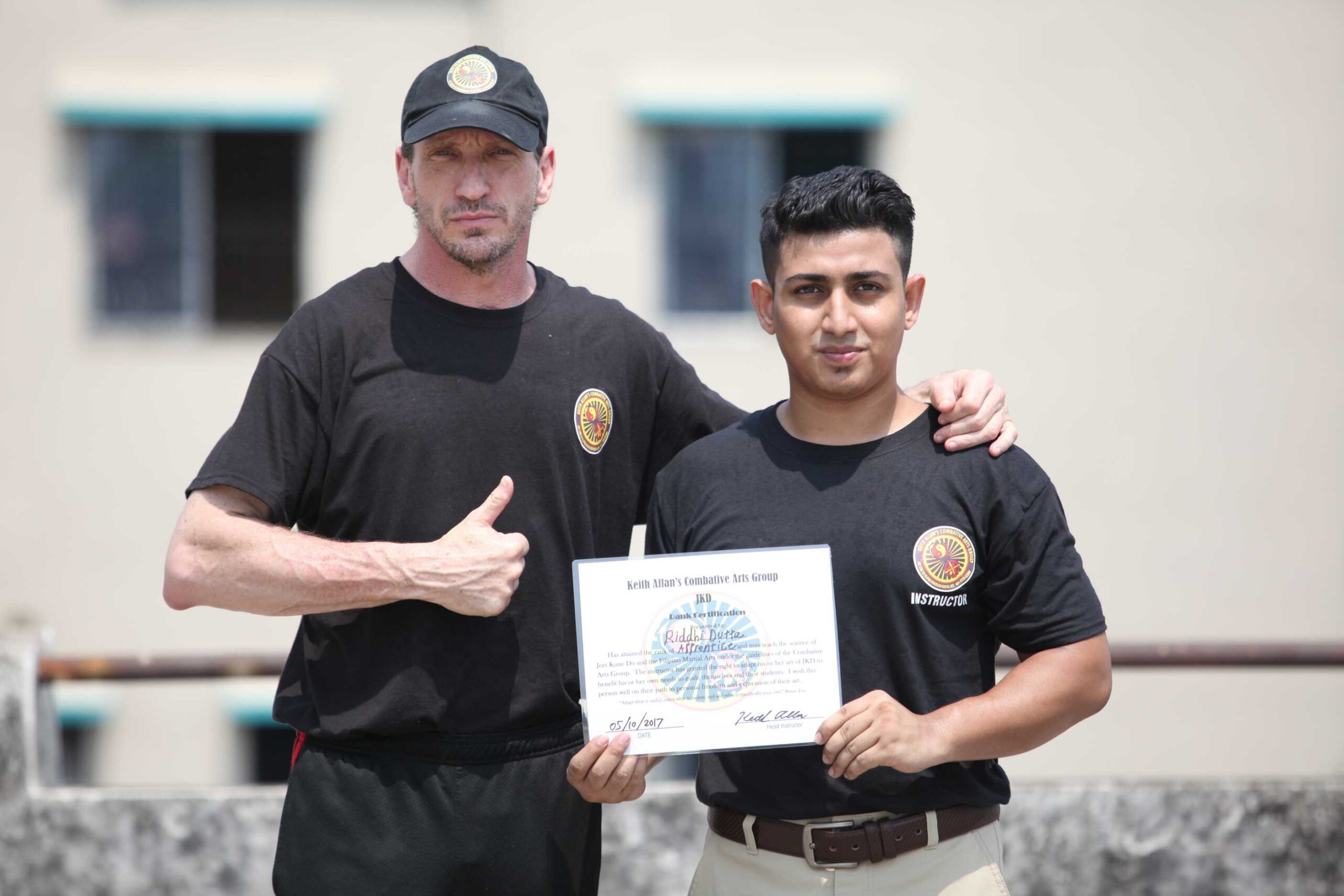
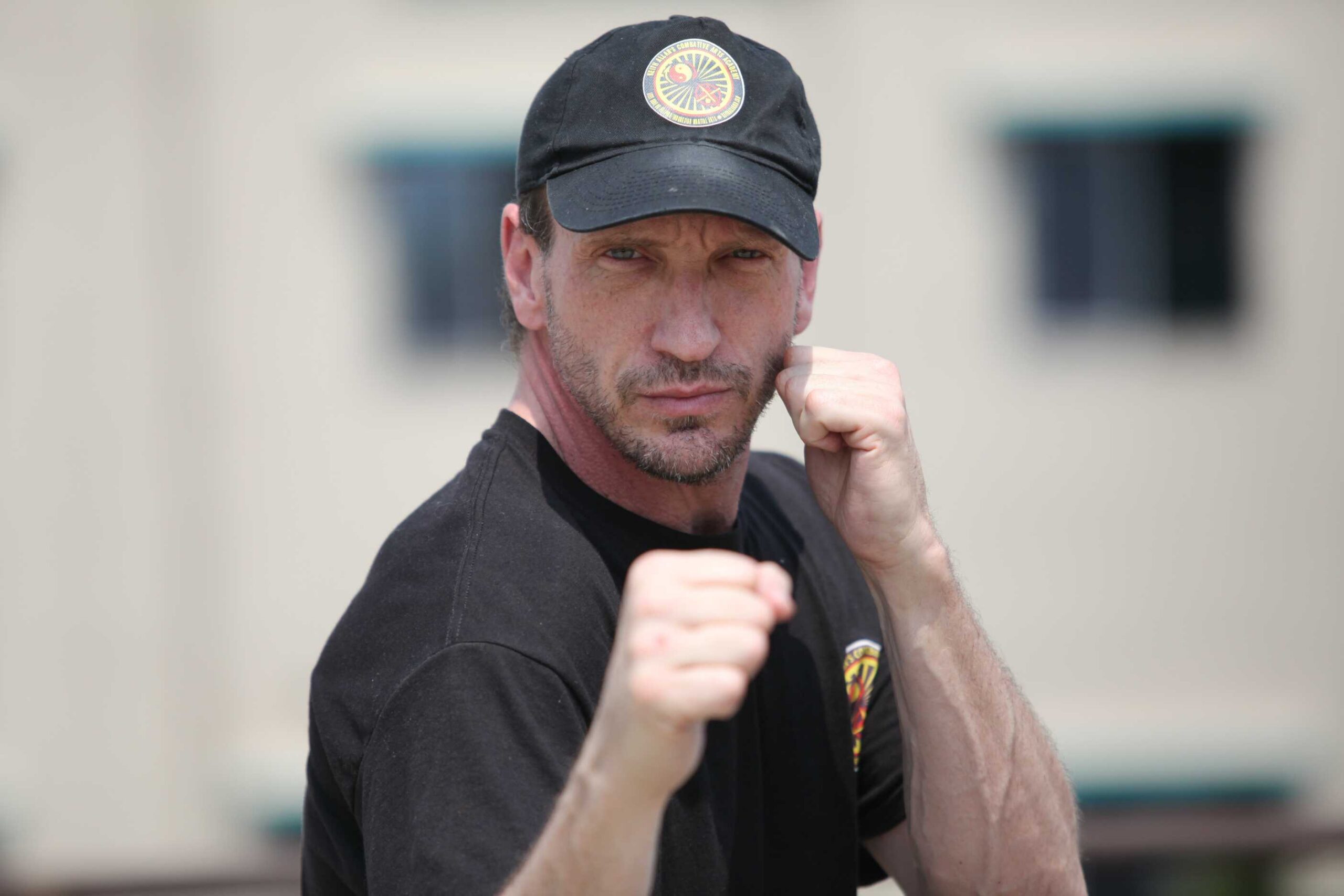
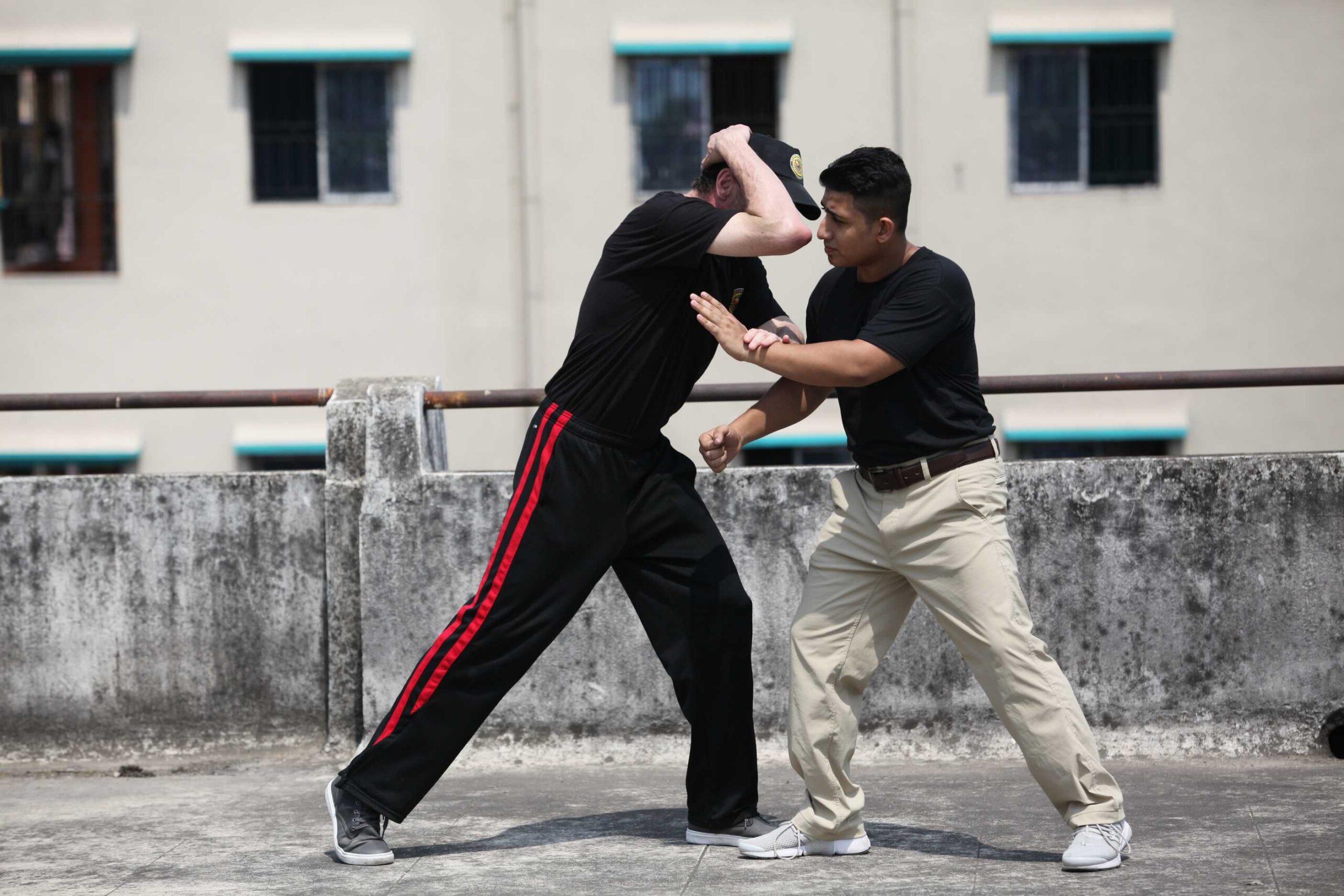
Riddhi Dutta is the One and Only Indian Instructor certified by Late Sifu Keith Allan in Jun Fan Jeet Kune Do and JKD Kali Blend. He’s had an extensive background in Martial arts with about 20 years of experience from a very early age. He studied Wing Chun, Western Boxing, Wus Shu Sanda and Sword Fencing Philippines Style, which is probably why Jeet Kune Do was a good fit for him. He was inspired by Bruce Lee at an early age watching his movie “The Chinese Connection”. As a security training contractor and VIP protection specialist, he taught several students starting from close combat and defensive tactics for special ops group, secret services to Personal Protection programs for experts, coaches, organisation and individuals, about how to survive in real life street violence which he has practical experiences of.
He was very fortunate to meet and train with Late Sifu Keith Allan. In 2017 he became a Private student of Keith and was trained exclusively by him to become an instructor and to conduct his classes in India. To keep the teachings of Jun Fan Jeet Kune Do as close to original as possible, Sifu Riddhi only teaches what he was taught by Sifu Keith which mostly came from 2 main sources (Paul Vunak’s Contemporary JKD / PFS and Tim Tackket’s WNG/China Town JKD Curriculum) that he studied directly from. According to Sifu Riddhi the best part of training with Sifu Keith was his flowy nature in movements, precise and direct strikes that felt very ballistic and penetrating where ever they landed and an even better sense of humour, he always made your training fun and you could see progress in every session. Today, Sifu Riddhi a very experienced martial artist and researcher who has travelled across many countries – training, researching and living martial arts, and has taught everyone from Amateurs to Professional Martial Arts Instructor, Law-enforcement and Spec Ops groups choses to teach his JKD / JKD-KALI program, how he was taught only in One on One Private Sessions or small very exclusive groups, open with teaching professional seminars, workshops and Private Instructor Training and Certification Program.
He is not very interested in JKD World Politics and his only Interest in Propagating JKD is to Keep his Teacher’s Legacy Alive !